
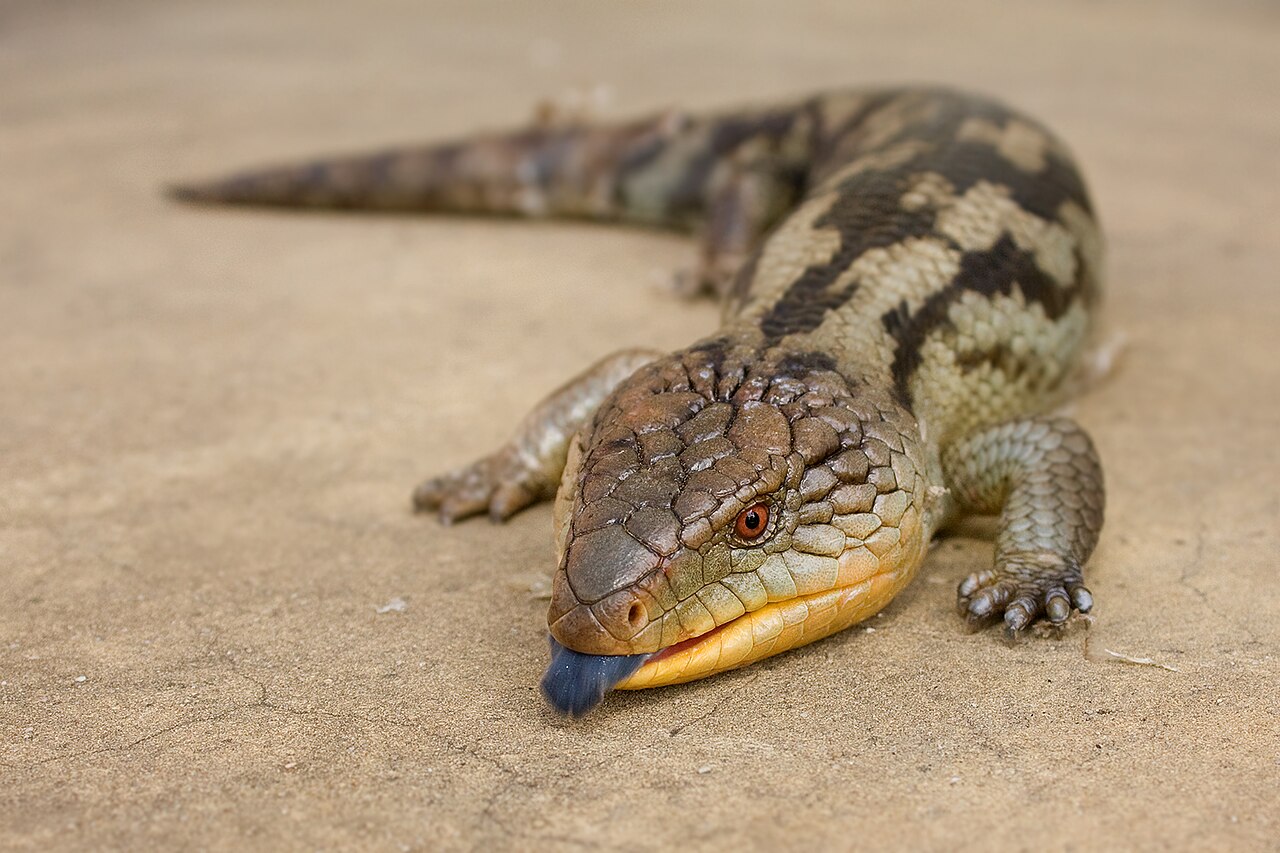
Blue-Tongued Skink
Tiliqua scincoides
A large, stout Australian skink known for its bright blue tongue, calm temperament in captivity, and opportunistic omnivorous diet of plants, insects, and snails.
Overview
The blue-tongued skink (Tiliqua scincoides), also called the common, eastern, or northern blue-tongue depending on subspecies, is a large terrestrial skink native mainly to northern and eastern Australia, with one subspecies on Indonesia's Tanimbar and Babar islands. It is diurnal, ground-dwelling, and omnivorous, using powerful jaws and enlarged rear teeth to crush snails and insects. Captive-bred animals are widely kept for their stout build, blue-tongue threat display, and generally calm handling temperament when properly housed.
Native Regions
Eastern, southeastern, and northern Australia, Tanimbar and Babar Islands, Indonesia (subspecies T. s. chimaerea)
Habitats
Coastal heath and grassland, Open woodland and dry sclerophyll forest, Montane woodland (not alpine or rainforest), Suburban gardens, parks, and urban edges
Adult Length
Typically about 17-22 inches total length; maximum near 24 inches
Adult Weight
Often about 280-510 grams; larger adults may approach about 1 kilogram
Lifespan
15–20 years
For Beginners
Many keepers find captive-bred blue-tongues approachable, but they still need a large adult footprint (about 4 x 2 feet minimum), UVB, thermostat-controlled heat, solitary housing, and a mixed diet with supplementation. This record treats them as beginner-friendly only when those basics are budgeted and maintained.
For Experienced Keepers
Experienced keepers can refine subspecies-specific humidity and climate, seasonal photoperiod, brumation decisions after veterinary clearance, naturalistic digging enrichment, and breeding while avoiding cohabitation and overfeeding fruit or unvetted dog-food staples.
Key Points
- › Provide a long terrestrial enclosure with a measured heat gradient, UVB, and solitary housing.
- › Feed a varied omnivorous diet that shifts from protein-heavier juveniles to plant-heavier adults.
- › Never house with conspecifics; bites are uncommon but powerful and non-venomous.
Appearance & Behavior
Adults are bulky, short-legged skinks with smooth overlapping scales, a triangular head, and a thick tapering tail shorter than the body. Total length commonly averages near 17-18 inches and can approach about 24 inches. Coloration varies by subspecies: eastern animals are often silvery-gray to brown with dark crossbands and a dark streak behind the eye; northern animals tend to be richer brown with less distinct cream-orange banding. The broad blue tongue is flashed during defense displays.
Normal Behavior
These lizards are mainly diurnal. They bask to warm, then forage along the ground for plants, snails, insects, and other opportunistic foods, returning to cover under logs, leaf litter, rocks, or burrows. Midday field body temperatures around 86-95°F are reported. They are relatively slow movers and may hiss, inflate or flatten the body, and display the blue tongue when threatened.
Social Behavior
Blue-tongues live alone for most of the year in nature and are territorial toward other blue-tongues. Captive cohabitation, including of juveniles, can cause severe injury or death. House one animal per enclosure except for brief, planned breeding introductions by experienced keepers.
Warning Signs
Open-mouth breathing, wheezing, nasal or oral discharge, swollen or soft jaws, tremors, incomplete sheds especially on toes or tail tip, swollen joints, lethargy with weight loss, diarrhea, mouth lesions, mites or ticks, or sudden appetite collapse warrant husbandry review and prompt exotic veterinary care.
Key Points
- › A stout, banded Australian skink with a conspicuous blue tongue.
- › Diurnal and ground-dwelling; defense relies on display more than speed.
- › Solitary housing is required.
Enclosure & Environment
Enclosure Size
Adult minimum about 48 x 24 x 24 inches (1.2 x 0.6 x 0.6 m). Credible care guidance commonly recommends 1.2-1.8 m length; larger floor area is preferred for thermal choice and enrichment.
Enclosure Type
Front-opening glass, PVC, or similarly smooth, non-absorbent vivarium with a secure lid or doors and strong ventilation.
Substrate
Use a diggable, low-dust mix such as soil-based substrate, bark, or other keeper-vetted bedding that allows burrowing and spot cleaning. Paper products suit quarantine but not long-term digging. Avoid persistently wet bedding, loose pure sand as a sole substrate, and materials that cause intestinal obstruction if ingested in quantity. A rough slate or tile area can help wear nails.
Heating
Create a daytime gradient with a basking surface about 95-105°F, cooler areas about 70-80°F, and warm-end air near the mid-80s°F so the animal can reach preferred body temperatures in the low 90s°F. Use overhead halogen or equivalent basking heat on a thermostat, probe and infrared thermometers, and lightless supplemental heat only if nights would fall below about 65°F.
Humidity
For Australian T. scincoides, maintain about 40-60% ambient humidity measured on the cool-side floor with a digital hygrometer. Provide good ventilation; chronically higher humidity can promote respiratory and skin problems, while prolonged dryness can impair shedding. A localized humid hide can help during sheds without soaking the whole enclosure.
Lighting
Provide roughly 12 hours of bright daytime light and darkness at night, adjusted seasonally if desired. Supply accessible linear UVB over the warm half of the enclosure with no glass or plastic between lamp and animal; replace or radiometer-test bulbs on the manufacturer schedule. Target roughly UVI 3-4 in the basking zone when measured.
Décor & Enrichment
Offer hollow logs, caves, or PVC hides on warm and cool ends, stable low climbing obstacles, leaf litter, and visual cover. Keep décor sparse enough for movement and cleaning. Provide a shallow, heavy water dish.
Cleaning & Maintenance
Remove feces and soiled substrate daily, refresh water daily, replace substrate on a regular schedule, and deep-clean with a reptile-safe disinfectant such as F10 SC used per label after debris removal. Track temperatures, humidity, weight, feeding, and sheds.
Key Points
- › Minimum adult footprint about 4 x 2 x 2 feet with a full gradient.
- › UVB, overhead basking heat, and solitary housing are core requirements.
- › Target roughly 40-60% humidity with strong ventilation.
Diet & Nutrition
Blue-tongued skinks are opportunistic omnivores. Wild diets include flowers, fruits, foliage, fungi, insects, snails, occasional small vertebrates, and carrion. Captive diets should combine leafy greens and vegetables with appropriately prepared animal protein and limited fruit.
Food Types
Staples include dark leafy greens, mixed vegetables, gut-loaded insects, farm-raised snails, and earthworms. Occasional egg and small amounts of fruit are acceptable. Formulated lizard diets may contribute a minority of intake. Wet dog food is controversial and, if used at all, should remain a small non-staple portion. Do not feed wild snails from baited gardens or pesticide-exposed prey.
Feeding Schedule
RSPCA guidance: babies up to 3 months daily; juveniles 3-8 months about 3 times weekly; animals 8+ months about 1-2 times weekly. Unusual Pet Vets similarly supports daily juveniles and every 1-2 days for adults when portions are modest; adjust to measured body condition and avoid obesity.
Supplements
Dust protein feeds with calcium carbonate without vitamin D3 or phosphorus on the schedule above when UVB is provided. Sprinkle a multivitamin on vegetables about every 1-2 weeks. Do not stack high-dose vitamin D3 powders when strong UVB is already provided without veterinary direction.
Hydration
Provide fresh drinking water daily in a shallow stable dish. Some animals soak; keep water clean and the surrounding substrate from staying wet.
Preparation
Offer food late morning after basking opportunity. Gut-load insects 12-24 hours before feeding. Dust insects with calcium immediately before offering. Chop or grate firm vegetables for digestibility. Remove uneaten food the same day.
Common Mistakes
Avoid exclusive dog-food diets, fruit-heavy menus that promote dental disease, under-supplemented growing animals, oversized live prey that can injure the skink, co-feeding multiple skinks, and free-choice overfeeding that causes obesity or hepatic lipidosis risk.
Key Points
- › Omnivore: greens plus insects/snails, with age-adjusted protein ratios.
- › Feed juveniles more often than adults and monitor body condition.
- › Calcium dusting and limited multivitamins support UVB-based husbandry.
Handling
Settled captive-bred blue-tongues are generally tolerant of careful handling and are popular for that reason, but handling is a human activity, not proof the animal enjoys contact.
Techniques
Support the torso with both hands so the body is fully cradled. Keep sessions brief at first. Wash hands before and after. Approach calmly and avoid sudden overhead grabs.
Do's & Don'ts
Never grab the tail; these skinks can drop their tails, and regenerates are energetically costly and imperfect. Do not handle during acclimation, deep shed, or immediately after large meals. Avoid mistaking fingers for food. Supervise children closely.
Taming
Allow reliable feeding and exploration first, then increase contact gradually. Many animals become calmer with predictable, low-stress routines rather than frequent forced handling.
Stress Signals
Persistent hissing, body inflation or flattening, gaping with blue-tongue display, frantic escape attempts, or biting indicate that handling should stop and husbandry or approach should be reassessed.
Key Points
- › Support the whole body; never lift by the tail.
- › Bites are uncommon but powerful and non-venomous.
- › Stop when threat displays escalate.
Health & Wellness
Common Health Issues
Nutritional secondary hyperparathyroidism (metabolic bone disease)
Description
Calcium and vitamin D imbalance from inadequate UVB, poor diet, or incorrect supplementation leading to weakened bone and muscle function.
Symptoms
Soft or swollen jaws, tremors, lethargy, reluctance to move, bent limbs, or fractures.
Prevention
Provide measured UVB, a balanced calcium-rich diet, and appropriate calcium supplementation without overdoing vitamin D3 when UVB is present.
Treatment
Contact a qualified exotic veterinarian promptly; do not attempt home dosing of prescription vitamins or medications.
Dysecdysis and retained shed
Description
Incomplete shedding often linked to humidity, abrasion, or health problems.
Symptoms
Patches of stuck skin, constricted toes or tail tip, dull retained spectacles-equivalent skin folds, or irritation.
Prevention
Keep humidity in the Australian target range, offer a humid hide when shedding, and provide rough furnishings for assisted shedding.
Treatment
Seek veterinary care for constricted digits or persistent retained shed; avoid forceful peeling of living tissue.
Respiratory disease
Description
Infection or inflammation of the respiratory tract often associated with incorrect temperature, poor ventilation, or chronically improper humidity.
Symptoms
Open-mouth breathing, wheezing, bubbles or discharge from the nose or mouth, lethargy, and appetite loss.
Prevention
Maintain a proper thermal gradient, avoid stagnant damp air, and keep the enclosure clean.
Treatment
This is a veterinary emergency relative to husbandry tweaks alone; arrange exotic veterinary assessment quickly.
Obesity and hepatic lipidosis risk
Description
Excess caloric intake and low activity can lead to overweight body condition and fatty liver disease.
Symptoms
Heavy body condition, fat-filled tail base beyond normal reserves, reduced activity, and appetite changes.
Prevention
Feed age-appropriate portions, limit calorie-dense treats, and provide floor space for movement.
Treatment
Work with a reptile veterinarian on diet revision and diagnostics; do not crash-diet the animal.
Parasites and external pests
Description
Ticks, mites, and internal nematodes are reported on wild and sometimes captive animals.
Symptoms
Visible ticks under scales or in ear canals, mite dust, weight loss, abnormal feces, or lethargy.
Prevention
Quarantine new animals, avoid wild-caught prey and substrate risks, and keep husbandry clean.
Treatment
Diagnosis and treatment belong with a qualified exotic veterinarian; many antiparasitic drugs are prescription-only.
Preventative Care
Schedule exotic veterinary exams every 6-12 months, including fecal checks as recommended. Quarantine new reptiles for at least 3 months when practical. Weigh regularly, watch sheds and stools, and never allow unsupervised outdoor time where predators, escape, or toxic prey are risks.
Emergency Signs — seek vet care immediately
Collapse, severe open-mouth breathing, continuous bleeding, inability to use limbs, seizures, rapid swelling after trauma, prolonged egg- or neonate-bound straining in gravid females, or complete anorexia with marked weight loss require urgent exotic veterinary care. Clean any human bite wound and seek medical advice if infection signs appear.
Key Points
- › MBD, shed problems, respiratory disease, obesity, and parasites are key risks.
- › Prevent with UVB, diet, climate control, and solitary clean housing.
- › Illness and emergencies belong with an exotic veterinarian.
Breeding
Tiliqua scincoides is live-bearing (ovoviviparous). Embryos develop with placental support; young are born in membrane sacs that rupture at or soon after birth.
Preparation
Breed only healthy, mature, well-conditioned animals after veterinary review, with separate permanent housing, quarantine history, and homes for neonates. Do not improvise cooling or brumation for young or unhealthy animals.
Breeding Process
In Australia, mating is typically late winter to spring and births occur in summer after roughly 3-4 months of gestation. Males may fight and mating can leave scrape marks on females. Litters commonly near 10-11 young, with broader reported ranges.
Egg Care
Not applicable; there are no eggs to incubate. Provide the gravid female a secure solitary enclosure with excellent husbandry, hides, and veterinary support if she shows dystocia signs.
Hatchling Care
Neonates are independent soon after birth, often shed within days, and should be housed separately. Offer appropriately sized omnivorous food frequently and monitor hydration and weight closely.
Key Points
- › Live-bearing with typical litters near 10 young.
- › Gestation roughly 3-4 months after spring mating.
- › House neonates individually and plan placements in advance.