
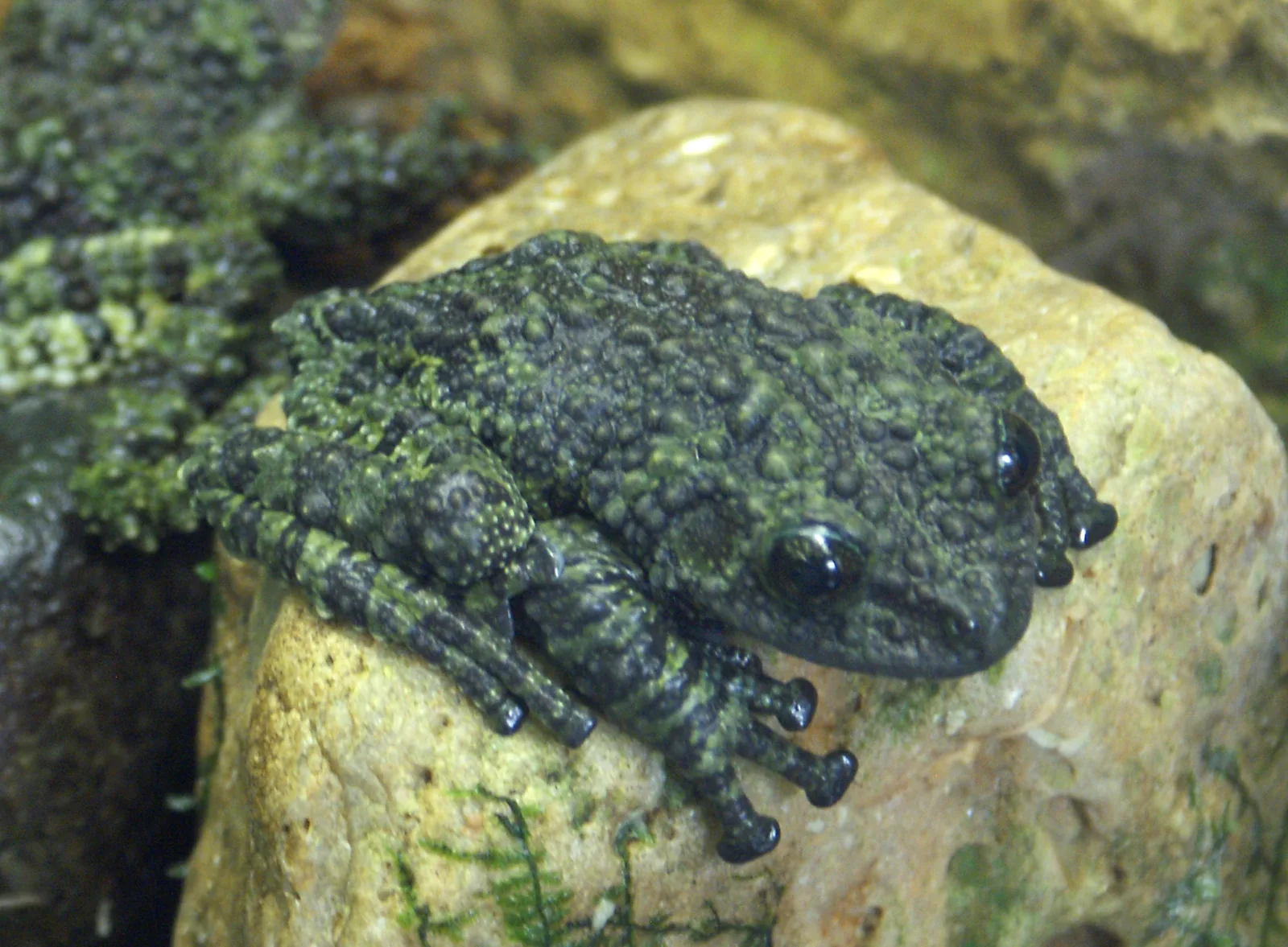
Vietnamese Mossy Frog
Theloderma corticale
A nocturnal, semi-aquatic moss-mimic from the montane forests of Vietnam. It needs a cool, humid paludarium with clean water and live insects, and it is a display animal rather than a frog to handle.
Overview
The Vietnamese mossy frog (Theloderma corticale, originally described as Rhacophorus corticalis) is a rhacophorid from montane northern and central Vietnam. Green, brown, and black tubercles break up its outline so a resting frog looks like moss on wet rock. It is nocturnal and semi-aquatic, using flooded caves, rock crevices, and water-filled tree holes. Captive-bred animals are established in zoos and the hobby, but they fail when the room is too warm or the water is dirty. This is a display frog: permeable skin and a habit of freezing or curling into a ball make routine handling a poor goal.
Native Regions
Northern Vietnam, Central Vietnam
Habitats
Montane evergreen rainforest, Limestone caves and flooded rock cavities, Water-filled tree holes, Rocky mountain streams
Adult Length
About 2.6-3.0 inches (67-76 mm) snout-vent in a measured series; some zoo accounts describe females near 3.5 inches and males as smaller and more slender
Adult Weight
Adult weight is not well published. Females are often described as heavier-bodied than males.
Lifespan
8–15 years
For Beginners
A poor first amphibian. The frog itself is often calm and visible, but the keeper has to hold a room in the mid-60s to low-70s °F, keep humidity high without stale air, and maintain a pool that does not build ammonia. Live-insect feeding and almost no handling are part of the job. Intermediate keepers who can cool a space in summer are a better match than beginners.
For Experienced Keepers
Experienced keepers can run a filtered paludarium or a tall water-and-land setup, use a seasonal cool period near the upper 50s °F if they want to condition breeding, and rear tadpoles only with a plan for water quality and many froglets. Do not mix this species with other amphibians. Buy captive-bred animals; the Smithsonian states that Vietnam protects the species and that wild collection and habitat loss are pressures.
Key Points
- › Cool, humid, semi-aquatic display frog from Vietnam's montane forests
- › Needs clean dechlorinated water, climbing cover, and live insects
- › Heat above the high 70s °F is the main captive risk
Appearance & Behavior
Adults are stocky tree frogs with rough skin, spines, and tubercles in mossy green, brown, reddish-brown, and black. A measured series gave males about 67-76 mm snout-vent length and females about 69-75 mm, so the sexes overlap in length. Zoo accounts instead describe females as larger and heavier, sometimes near 3.5 inches, and males as more slender. Large toe pads grip wet rock and bark. Males develop a nuptial pad, described as a breeding callus or a red pad, on the inner finger; it can swell in the breeding season. The call is a quiet hoot or whistle, and the Smithsonian reports that calling males can be hard to locate because the voice seems to come from several feet away.
Normal Behavior
These frogs are nocturnal. By day they rest in water under cover, on floating plants, or pressed into mossy crevices with the body flattened. At night they climb and hunt insects within a short distance of the retreat. If disturbed they may freeze, curl into a ball, or play dead. Males call mainly in the evening; calling has also been heard occasionally by day in a breeding facility.
Social Behavior
Pairs and small groups are the usual captive arrangement. In Vietnam, animals have been found as a pair or as one male with two or three females in a shared retreat. House only similar-sized frogs of this species, give several resting spots and feeding sites, and separate any animal that loses weight or is kept off the cover. Do not mix species. Adult males call at night; the call is quieter than that of many tree frogs but it is still a night sound.
Warning Signs
Frantic climbing, gaping, constant soaking, collapse, or unusual stillness in a warm enclosure suggest overheating. Red skin, cloudy film, sores, repeated poor sheds, weak grip, weight loss, bloating, abnormal floating, or a frog that stops eating for more than a few feedings need a husbandry review and veterinary advice.
Key Points
- › Moss-textured green and black frog, usually about 2.6-3.0 inches long
- › Nocturnal; rests in or beside water and may curl into a ball when frightened
- › Pairs and small same-species groups can work if every frog is seen eating
Enclosure & Environment
Enclosure Size
A zoo care sheet recommends an 18 x 18 x 18 inch enclosure for a pair and about 24 x 18 x 18 inches for three or four adults. A taller 18 x 18 x 24 inch setup is a practical alternative for a small group because egg sites and climbing cover need height. Zoo breeding enclosures are much larger. The 18-inch cube is the minimum for one adult or a pair, not a starter size to outgrow.
Enclosure Type
Glass aquarium or a terrarium whose seams are sealed for standing water. A screen top alone will not hold humidity; cover most of the top and leave ventilation so air does not go stale. This is not an aquarium species that should be forced to swim in deep open water.
Substrate
A simple, cleanable layout can use large river rock to form a land edge, moss on the land, and floating cork. Leaf litter and moss work on a terrestrial section if drainage water stays out of reach. Paper towel is better for quarantine. Avoid fine gravel that can be swallowed and aromatic wood.
Heating
Keep daytime air around 66-74°F. A mild warm pocket of about 72-77°F is acceptable only if the rest of the enclosure stays cooler and the frogs can leave it. Nights around 58-68°F match the recommended drop. Do not hold the enclosure above about 77°F, and treat sustained temperatures of 80°F or higher as dangerous. In summer, use a basement, air conditioning, or another cool room. A seasonal rest near 59°F has been used at a zoo to condition breeding; that is a planned cool period, not a reason to let a tank swing uncontrolled. Measure air and water with a probe thermometer.
Humidity
Maintain about 70-90% relative humidity with enough airflow that surfaces are not permanently slimy. Some keepers aim to stay above 80%. Brief dips toward 50% are described as tolerable only when clean water is available; a dry tank without water can kill these frogs. Mist with the same dechlorinated water used in the pool.
Lighting
Use a 10-12 hour photoperiod. A full-spectrum or plant fluorescent is appropriate; incandescent bulbs add heat and are a poor choice. Low-output UVB in Ferguson Zone 1, with shaded cork and water retreats near zero UVI, is a reasonable optional addition. No species-specific UVB trial was found, and successful zoo breeding has been reported under ordinary fluorescent light. Do not use a bright basking lamp.
Décor & Enrichment
Provide cork tubes or flats, branches that enter the water, broad leaves, and rough but not abrasive resting spots above the waterline. Eggs are laid on vertical surfaces a few centimeters above water, so those sites matter if the frogs are adult. Floating cork gives extra islands. Keep at least one easy exit from every pool.
Cleaning & Maintenance
Siphon feces and uneaten food daily. Test pool water and change it when ammonia rises; a filter does not replace water changes. Rinse dechlorinator thoroughly out of any tool that will touch the frogs only after the treated water is safe for amphibians, and never use household cleaners in the tank. Keep nets and cups separate from other amphibian enclosures.
Key Points
- › Minimum about 18 x 18 x 18 inches for one adult or a pair, with a real pool
- › Daytime air about 66-74°F; do not rely on a heat lamp
- › Humidity about 70-90% plus clean, dechlorinated water
Diet & Nutrition
An insectivorous frog. Zoos feed gut-loaded crickets as the staple, often with cockroaches, and the Smithsonian also offers earthworms. Variety is useful; one insect species is not a complete plan.
Food Types
Staples are gut-loaded crickets and roaches or cockroaches. Earthworms, locusts where legal, cultured moths, and flies are reasonable additions. Soft larvae such as silkworms or waxworms are occasional foods, not the base diet. Do not offer wild-caught insects that may carry pesticides.
Feeding Schedule
At two breeding facilities, adults were fed about every second to third day and froglets about every second day. Offer food in the evening when the frogs are active. Remove uneaten insects the same night so they do not drown or bite resting frogs.
Supplements
Zoo diets dust insects with a mineral and vitamin supplement at feeding. For growing frogs, use calcium on most meals and a multivitamin about weekly. For adults with low-level UVB, calcium about once or twice a week and a multivitamin every few weeks is a conservative schedule. If there is no UVB, use a D3-containing calcium product on a limited schedule and do not combine several D3 supplements. Poor mineral support is a recognized route to weak bones, tremors, and poor posture in insect-eating amphibians.
Hydration
The pool is the main water source. Use rainwater or tap water treated with an amphibian-safe dechlorinator. Aging water in an open bucket is not a complete treatment plan on its own. Change or filter the pool so ammonia stays undetectable, and mist with the same water.
Preparation
Gut-load feeders for about 24-48 hours. Prey should be no wider than the space between the eyes. A floating cup lined with damp paper, set on the water, keeps dusted crickets from washing off their supplement and drowning. Dust immediately before feeding.
Common Mistakes
Cricket-only diets without gut-loading, letting supplements wash off in the pool, leaving insects in overnight, overfeeding fatty larvae, and using untreated tap water.
Key Points
- › Gut-loaded crickets and roaches, with earthworms and other insects for variety
- › Juveniles every 1-2 days; adults every 2-3 days in the evening
- › Dust feeders and keep supplement from being rinsed off in the water
Handling
This is a hands-off terrarium animal. Skin is moist and permeable, and the usual defense is to freeze or curl into a ball rather than tolerate being held.
Techniques
Move frogs in a clean, rinsed, ventilated cup whenever possible. If contact is unavoidable, use wet powder-free gloves or freshly rinsed wet hands, support the body briefly, and put the frog down. Keep sessions short.
Do's & Don'ts
Do not handle with dry, soapy, lotioned, or nicotine-contaminated hands. Do not chase a frog around the tank or use a rough net. Wash after contact. There is no medically significant venom; the risk is skin injury and stress, not a bite.
Taming
These frogs do not become handling pets with practice. They settle when the room stays cool, the water stays clean, and they are left on their moss and cork.
Stress Signals
Stop if the frog curls tightly, goes limp and plays dead, secretes excess mucus, jumps repeatedly, or darkens and refuses to settle. A frog that only freezes may already be stressed.
Key Points
- › Display only; move with a cup
- › Wet, residue-free hands or gloves if contact is unavoidable
- › Curling into a ball is a stress response, not a handling trick
Health & Wellness
Common Health Issues
Overheating
Description
This montane frog handles cool air better than heat. Zoo and husbandry sheets treat the upper 70s °F as the edge of comfort and temperatures of 80°F or higher as potentially fatal.
Symptoms
Frantic movement, gaping, lethargy, collapse, or unusually constant soaking in a warm, still enclosure.
Prevention
House the frog in a room that stays about 66-74°F by day, measure air and water, and do not use heat lamps or heat rocks. Plan summer cooling before acquiring the animal.
Treatment
Move the enclosure to a cooler room and contact a qualified amphibian veterinarian if the frog is weak, collapsed, or not recovering. Do not chill a frog in ice water as a home treatment.
Skin and water-quality infection
Description
Bacterial and fungal skin infections have occurred in both a Vietnamese breeding station and a European zoo. Dirty water, high ammonia, and stagnant humid air are the usual husbandry drivers.
Symptoms
Redness, cloudy or peeling skin, sores, excess mucus, or a foul film on the water.
Prevention
Use dechlorinated water, remove waste daily, test ammonia, and keep airflow with the humidity. Quarantine new frogs for weeks to months with separate tools.
Treatment
This is not a home diagnosis. Fungal and bacterial skin disease need a qualified amphibian veterinarian; do not apply over-the-counter reptile creams.
Nutritional bone and muscle weakness
Description
Insect-only diets without gut-loading and mineral dusting can produce metabolic bone disease. A controlled UVB study for this species was not found, so supplementation still matters whether or not a low UVB tube is used.
Symptoms
Weak grip, tremors, crooked posture, soft jaws, or fractures.
Prevention
Gut-load insects and dust on the schedule above. Match D3 to the UVB plan and do not stack D3 products.
Treatment
Stop improvising supplements and see a qualified amphibian veterinarian. Diet correction is supportive care, not a substitute for an exam.
Preventative Care
Quarantine new animals, ideally 60-90 days, and ask a veterinarian about fecal and chytrid screening. Zoos test incoming frogs for Batrachochytrium dendrobatidis because amphibians can carry it; a species-wide outbreak was not documented in the sources read here. Weigh or at least body-score the frogs regularly, keep written temperature and water notes, and never share soaking water or tools with other amphibians.
Emergency Signs — seek vet care immediately
Collapse or gaping in the heat, skin ulcers, bleeding, severe bloating, floating upside down, seizures or tremors, a major wound, or a frog that is limp and unresponsive. Contact a qualified amphibian or exotic veterinarian the same day. Do not release a sick pet.
Key Points
- › Heat and dirty water are the main preventable problems
- › Skin infections need a veterinarian, not a home remedy
- › Quarantine new frogs and dust gut-loaded insects
Breeding
In Vietnam the breeding season runs from about March to October. Frogs use tree holes and small caves partly filled with water, often in limestone, and also use man-made water-holding cavities in forest. Captive frogs have spawned from March to September after a cool period, and other keepers report spawning in the northern winter. A cool rest followed by warmer, wetter conditions and a slightly higher water level is the most repeatable trigger described by zoos.
Preparation
Breed only healthy, captive-bred adults, and only with space for tadpoles and froglets. Confirm local rules before moving eggs or offspring. Provide vertical bark, cork, or rock a short distance above clean water. Cologne Zoo cooled frogs to about 59°F for the winter, then raised temperature, spraying, and water level. Sexes are not reliably separated by a fixed length; listen for the male's hoot and look for nuptial pads. Reports of temperature-dependent sex ratios conflict and are not an established method for producing females.
Breeding Process
Amplexus is axillary and usually occurs in the water. Eggs are placed singly or in a loose group on bark, wood, or panels above the water, often within about 15 cm of the surface and commonly only a few centimeters up. Clutches at two facilities ranged from 6 to 47 eggs; field and husbandry accounts also report usual clutches around 15-30 and occasional clutches up to about 70. A zoo fact sheet's figure of 8-10 eggs is lower than those series. Adults are often left near the clutch; some eggs that fall into poorly oxygenated water fail.
Egg Care
Hatching is commonly about 7-18 days and is faster in warmer water. Keep eggs moist so they do not dry, with high humidity or light misting. If eggs must be moved, shallow clean water or a moist container is used by breeders; land-laid eggs have survived better than submerged eggs in several reports. Tadpoles then need a filtered or frequently refreshed container, hiding tubes, and guarded intakes. Published rearing temperatures are mostly about 68-79°F. Fish-food flakes are a proven staple, with bloodworms later; newly hatched tadpoles still have yolk for a few days and then must be fed. Development at 68°F took about 4.5 months in one zoo study, versus about 3 months in warmer accounts. Some tadpoles take up to 6 months and grow larger.
Hatchling Care
Froglets emerge around 0.8-1.0 inch (about 20-25 mm), sometimes with a short tail stub. Offer a low water level they can leave, moss or leaf cover, and tiny crickets starting about a week after they climb out. Feed every couple of days, dust small prey, and keep the setup cool and clean. Raise young separately or in small groups so larger tadpoles are not crowded; cannibalism is mentioned as a crowding risk in the husbandry literature.
Key Points
- › Eggs are laid above water in cavities, usually in clutches of about 10-50
- › Hatching in about 7-18 days; metamorphosis often takes 3-4.5 months
- › Do not breed without a tadpole and froglet plan