
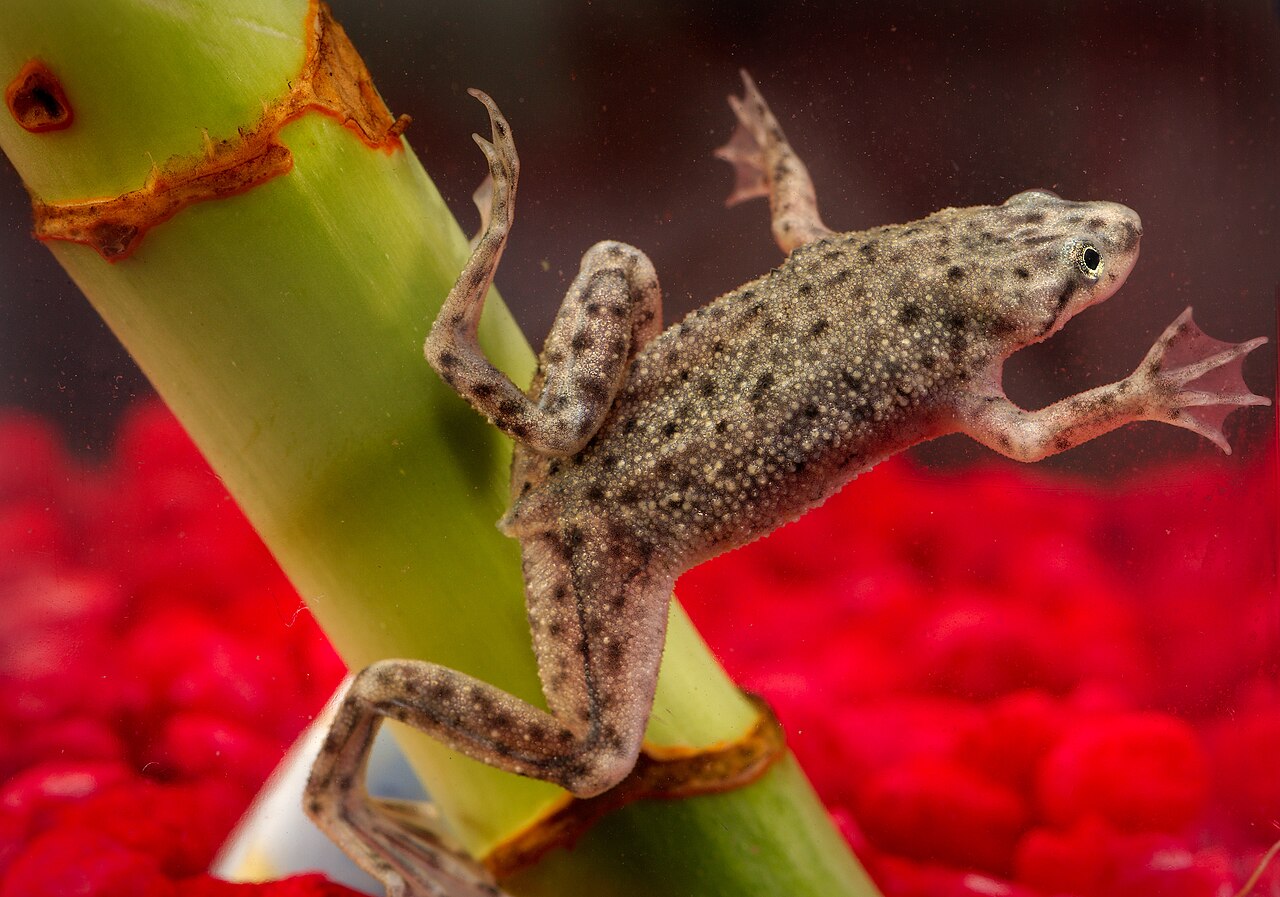
African Dwarf Frog
Hymenochirus boettgeri
A tiny, fully aquatic Central African frog best observed in a calm, well-cycled aquarium with gentle filtration and reliable target feeding.
Overview
Hymenochirus boettgeri is a small, lung-breathing frog that remains aquatic throughout life. It inhabits still, slow, or stagnant freshwater in forested Central Africa and must be able to reach the surface easily. Its modest space needs are offset by strict water-quality, feeding, escape-prevention, and biosecurity requirements.
Native Regions
Southern Nigeria, Cameroon, Central African Republic, Equatorial Guinea, Gabon, Republic of the Congo, Democratic Republic of the Congo
Habitats
Still and slow-moving freshwater, Forested pools and ponds, Stagnant waters in subequatorial forest
Adult Length
Up to 1.4 inches snout-to-vent (35 mm)
Adult Weight
About 0.7-0.9 grams in studied adults
Lifespan
5–8 years
For Beginners
Often sold as a beginner pet, but a new keeper must first learn aquarium cycling, water testing, dechlorination, gentle filtration, and target feeding. A stable, fully cycled setup should be running before frogs arrive.
For Experienced Keepers
Experienced keepers can refine group housing, nutrition, quarantine, and breeding while tracking water chemistry closely. New arrivals warrant strict biosecurity because pet-trade frogs may carry chytrid or other pathogens.
Key Points
- › Fully aquatic but must surface to breathe air
- › Needs warm, stable, dechlorinated water and gentle filtration
- › Usually does best in a species-focused setup where feeding can be observed
Appearance & Behavior
A small brown, olive, or gray mottled aquatic frog with long hind limbs and webbing on all four feet. Females are broader and may reach 35 mm snout-to-vent; males are slimmer and develop a visible post-axillary gland. Studied adults averaged roughly 0.7-0.9 grams.
Normal Behavior
Normal frogs rest among plants or shelters, forage along the bottom, swim through the water column, and make quick trips to the surface for air. Activity and male calling often increase after dark.
Social Behavior
Conspecific group housing is generally appropriate when space, shelters, water quality, and food access are adequate. Males can call and show territorial breeding behavior. Species-only housing reduces competition and predation risk; mixed-species tanks require especially close feeding observation.
Warning Signs
Failure to eat, persistent floating or inability to submerge, loss of balance, unusual swimming, marked lethargy, weight loss, swelling, sores, redness, skin discoloration, or excessive shedding are warning signs.
Key Points
- › A fully aquatic, primarily nocturnal frog
- › Females are larger and broader than males
- › Group housing is possible, but every frog must be seen eating
Enclosure & Environment
Enclosure Size
A 10-gallon aquarium measuring about 20 by 10 by 12 inches is a conservative minimum for a pair or small group. This aligns with a veterinary-reviewed 40-litre recommendation and the 38-litre, 50 by 25 by 30 cm group tanks used in published husbandry.
Enclosure Type
Covered, fully aquatic freshwater aquarium with calm flow and unobstructed surface access.
Substrate
Use fine smooth sand, a bare bottom, or rounded gravel too large to swallow. Published husbandry used gravel larger than 1 cm to prevent ingestion. Avoid sharp or mouth-sized stones.
Heating
Maintain stable water at 72-79°F (22-26°C), measured with a submerged thermometer. The published laboratory system held frogs at 77°F (25°C). There is no basking site, and a deliberate nighttime temperature drop is not required.
Humidity
Atmospheric humidity is not a meaningful control variable for this fully aquatic species. The catalogue value of 100% denotes continuous immersion, not an air-humidity target; water chemistry and temperature are the relevant measurements.
Lighting
Provide a consistent day-night cycle with moderate, low-heat aquarium lighting and shaded retreats. Species-specific evidence that UVB is required is lacking; successful published husbandry used a timed light cycle without describing UVB. Avoid intense light and overheating.
Décor & Enrichment
Provide dense live or soft artificial plants, smooth caves or pipe sections, and resting places near the surface. Keep an open feeding area and an easy path to air. Every opening must be escape-proof while allowing ventilation above the water.
Cleaning & Maintenance
Test temperature and water chemistry routinely, remove uneaten food promptly, and perform regular partial water changes with temperature-matched, dechlorinated water. Preserve the biological filter by avoiding untreated tap-water rinses, and quarantine new amphibians with separate equipment.
Key Points
- › Use at least a stable 10-gallon setup for a pair or small group
- › Keep water at 72-79°F with zero ammonia and nitrite
- › Provide gentle flow, smooth furnishings, a secure lid, and easy surface access
Diet & Nutrition
African dwarf frogs are aquatic carnivores that locate food by scent and movement. A varied diet and observed feeding are important because they can be slow to find food and may lose meals to fish.
Food Types
Use a nutritionally complete sinking aquatic-frog or small carnivore pellet as part of the staple rotation, together with frozen or safely cultured invertebrates such as bloodworms, brine shrimp, daphnia, and blackworms. Avoid relying on one prey item or unverified wild-collected food.
Feeding Schedule
Feed healthy adults two or three times per week and juveniles about every other day. Published adult husbandry successfully used three feedings weekly. Adjust portions to body condition and water quality rather than feeding by the clock alone.
Supplements
Use a complete formulated food to provide vitamins and minerals. General amphibian veterinary guidance emphasizes calcium, vitamin D3, and vitamin A adequacy, but no species-specific schedule for dusting aquatic frog food was found; use additional supplements only with a qualified exotic veterinarian's guidance.
Hydration
Hydration is continuous in a fully aquatic enclosure, but the water must be clean, dechlorinated, and chemically stable. The frog also needs clear access to the surface because it breathes with lungs.
Preparation
Thaw frozen food in a clean container and place small portions directly in front of each frog with feeding tongs, a pipette, or a turkey baster. Confirm that each animal eats, then remove leftovers.
Common Mistakes
Common errors include adding frogs before the aquarium is cycled, letting fish take their food, feeding only bloodworms, overfeeding, leaving leftovers to decay, using strong filter currents, and exposing frogs to chlorine or medication without amphibian-specific veterinary advice.
Key Points
- › Offer a varied carnivorous diet with a complete sinking food
- › Target-feed so every frog is observed eating
- › Remove leftovers quickly to protect water quality
Handling
This is an observation animal, not a routinely handleable pet. Its small body and permeable skin make removal from water and contact with bare hands unnecessarily risky.
Techniques
For essential transfers, guide the frog into a smooth container holding aquarium water or use an atraumatic soft net. Veterinary handling should use moistened, powder-free vinyl gloves, changed between animals.
Do's & Don'ts
Keep handling brief, keep the frog wet and at an appropriate temperature, and use residue-free equipment. Do not hold it in dry or bare hands, squeeze its limbs or body, use powdered or latex gloves, or expose it to soaps, lotions, disinfectant residue, or abrupt temperature changes.
Taming
Taming is neither necessary nor expected. Build predictable feeding responses through quiet target feeding while minimizing disturbance.
Stress Signals
Stop and seek appropriate help if the frog shows frantic escape attempts, loss of balance, abnormal swimming, weakness, prolonged immobility, or difficulty surfacing.
Key Points
- › Avoid routine handling
- › Transfer in water with a smooth container or soft net
- › Use moistened powder-free vinyl gloves only when direct contact is necessary
Health & Wellness
Common Health Issues
Water-quality-associated bacterial disease
Description
Poor water quality, crowding, malnutrition, and other husbandry stress can predispose amphibians to systemic bacterial disease; red-leg is a nonspecific syndrome rather than a diagnosis.
Symptoms
Lethargy, reduced appetite, weight loss, skin ulcers, ventral redness, pinpoint hemorrhages, swelling, or abnormal behavior.
Prevention
Maintain a fully cycled aquarium, zero ammonia and nitrite, stable temperature, appropriate stocking, prompt waste removal, quarantine, and separate clean equipment.
Treatment
Contact a qualified exotic veterinarian promptly. Diagnosis may require water testing, culture, cytology, or other testing; do not start aquarium antibiotics or salt treatment without amphibian-specific veterinary direction.
Chytridiomycosis
Description
Batrachochytrium dendrobatidis is an infectious skin fungus to which H. boettgeri is susceptible and which can spread through water, animals, and contaminated equipment.
Symptoms
Brown or red skin discoloration, excessive shedding or mucus, loss of coordination, lethargy, reduced appetite, or sudden death.
Prevention
Buy from a responsible source, quarantine new frogs, avoid shared water or tools, change gloves between groups, and disinfect equipment using an amphibian-safe protocol followed by thorough rinsing.
Treatment
Seek a qualified exotic veterinarian urgently for diagnostic testing and a supervised treatment plan. Do not attempt heat or antifungal treatment from internet instructions.
Mycobacteriosis
Description
Nontuberculous Mycobacterium species can cause opportunistic skin or systemic infection in captive aquatic amphibians and may present a zoonotic hygiene concern.
Symptoms
Gray skin nodules or ulcers, progressive weight loss despite eating, lethargy, or other chronic decline.
Prevention
Avoid crowding and unsanitary conditions, quarantine new animals, wear gloves for tank work when skin is broken, wash hands thoroughly, and never clean aquarium equipment in food-preparation areas.
Treatment
Contact a qualified exotic veterinarian; diagnosis and treatment require professional testing and case-specific risk assessment. People with skin lesions or health concerns after aquarium exposure should contact a physician.
Preventative Care
Record appetite, behavior, body condition, temperature, and water-test results. Quarantine new amphibians for a veterinarian-guided period, use separate tools, arrange access to an amphibian-experienced exotic veterinarian, and seek a diagnostic examination rather than treating visible signs as a specific disease.
Emergency Signs — seek vet care immediately
Prompt veterinary care is warranted for inability to surface, severe swelling, loss of balance, persistent abnormal swimming, open sores, hemorrhage or marked redness, excessive shedding, breathing difficulty, refusal of food with decline, profound lethargy, seizures, or sudden illness affecting multiple frogs.
Key Points
- › Water quality and biosecurity are central preventive care
- › Redness, bloating, and shedding are signs, not diagnoses
- › Illness and emergency treatment belong with a qualified exotic veterinarian
Breeding
Captive breeding can occur throughout the year. Males call and clasp females, and egg laying occurs at the water surface. Breeding creates hundreds of delicate offspring and should be attempted only with space, food, and a plan for them.
Preparation
Use healthy, correctly identified adults from a quarantined population. Published work observed male sexual glands from about five months and female spawning from about six months, but maturity depends on rearing conditions. Stable clean water and varied feeding are prerequisites.
Breeding Process
Following courtship and amplexus, females release eggs at the surface over repeated trips. Remove adults or move eggs promptly because adults may consume them. One published trial collected about 600 eggs from one pair over three days and about 200 from other breeding pairs.
Egg Care
Keep eggs near the surface in clean, stable water and protect them from adults and filter intakes. In published 77°F husbandry, eggs hatched within two days. Remove dead or fungused eggs with clean equipment.
Hatchling Care
Begin feeding when tadpoles swim freely, approximately one or two days after hatching. Published care used powdered fry food daily for one week, then newly hatched brine shrimp; metamorphosis averaged about five weeks, with some taking seven weeks. Separate markedly different sizes to reduce predation risk.
Key Points
- › Breeding may produce hundreds of eggs over several days
- › Eggs hatch in about two days near 77°F
- › Tadpoles need tiny foods, excellent water quality, and protected nursery space